CAPACITY
The mind holds a handful
Psychologist Nelson Cowan puts the central limit of working memory at 3 to 5 meaningful items in young adults. Past that, a list does the holding.
Check what to jot doodlenotepad
Start
WHAT THE RESEARCH SAYS
Psychologists call it cognitive offloading.

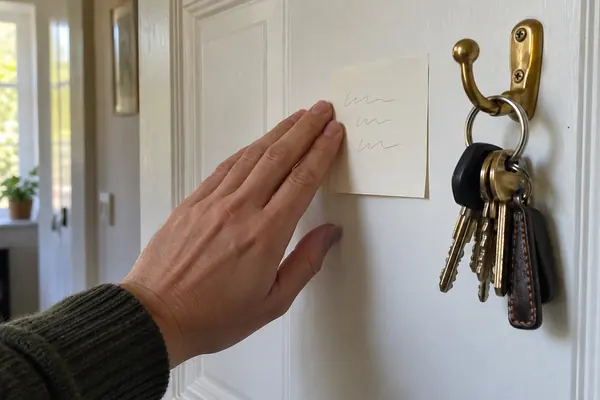
A shopping list, a note on the door, a reminder on the phone: we hand memory jobs to the world around us all the time. Research says it often helps, sometimes costs, and works best when you trust the note.
JOT ITthen let it go
Check what to jotKeep in mind
THE SHORT ANSWER
Working memory is small.
A note gives some of the load a place to live.
CAPACITY
Psychologist Nelson Cowan puts the central limit of working memory at 3 to 5 meaningful items in young adults. Past that, a list does the holding.
Check what to jotREMINDERS
Remembering to do something later is hard because nothing prompts you. In online experiments with 1,196 people, setting reminders improved performance on remembering to act.
See the numbersPLANS
Unfinished goals kept popping into people's minds during an unrelated task. Writing a specific plan for them made those intrusions disappear in a 2011 series of studies.
How to do itA QUICK CHECK
Pick what you are trying to hold on to. The bar shows how strongly the research points to writing it down.
Based on published memory research summarised below. Results come from lab and online experiments, mostly with students and volunteers.
TWO NUMBERS WORTH KNOWING
One figure on how much the mind holds,
one on how readily we reach for a pen.
3–5 items
Meaningful items held at once
Nelson Cowan's 2010 review describes a central memory store limited to 3 to 5 meaningful items in young adults, distinct from how much you can repeat back, which depends on the task.
WORKING MEMORY · COWAN 2010
≈ 40%
Writing down only two items
In a study described in the 2016 review, people chose to write items down about 40% of the time with only two to remember, and wrongly judged that it would help.
EXTRA NOTES · RISKO & GILBERT 2016
The same review notes that people with lower confidence in their memory set more reminders, even after allowing for how good their memory actually was.
FOUR HABITS TO TRY
None of these needs an app. They put a notepad to work at the moments the research says it helps most.

Step 1
Reminders work when they are noticed. Placing reminders in noticeable spots is a long-standing trick, and reminders improved performance in Gilbert's experiments.
Step 2
For a task you cannot finish now, write what you will do next and when. Specific plans are what quietened unfinished goals in the 2011 studies.
Step 3
Saving only freed memory when people believed the saved file would be there. One reliable place beats scraps everywhere.
Step 4
If you need it in your head later, read the note back and test yourself rather than relying on having it saved.
THE SAVING EFFECT
In a 2015 study by Benjamin Storm and Sean Stone, 20 students studied two short files of 10 common nouns each, 20 seconds per file. They remembered more from the second file when they had saved the first one rather than just closing it.
A second study with 48 students found the benefit vanished when they were told the saved file might not be there. Offloading frees the mind only when you trust the place you put things.
Questions
Risko and Gilbert define it as using physical action to change a task so it needs less mental effort, such as writing a shopping list, setting a phone reminder or tilting your head to read sideways text.
Nelson Cowan's 2010 review puts the central limit of working memory at about 3 to 5 meaningful items in young adults. How much you can repeat back depends on the task, but the underlying store is small.
In Sam Gilbert's 2015 online experiments with 1,196 participants, setting reminders improved performance, and people set them more when they had more to remember or were likely to be distracted.
It can for the thing you saved: people who expected typed trivia to be kept remembered it less well. But saving one set of words helped people learn the next set, so it is a trade rather than simple harm.
Unfulfilled goals tend to stay active in the mind. Masicampo and Baumeister found that making a specific plan for them stopped the intrusive thoughts and the interference with other tasks.
Destination
Updated
ABOUT THIS NAME
doodlenotepad.com is part of the DoodleSale portfolio. It isn't in an auction right now, but you can ask about leasing it.